Custom AI Agent Development Cost: A Practical 2026 Budget Guide
Custom AI agent development cost cannot be inferred from a market average or a token price alone. A credible budget separates paid scoping, one-time implementation, integrations, evaluation, security, and recurring operations. Start with a measurable scenario, model low, base, and high operating assumptions, then request a quote against that defined scope.
This guide presents a budgeting method, not a JDTeachAI rate card. Public prices below are USD component examples retrieved on August 5, 2026, excluding tax, currency conversion, enterprise contracts, regional terms, and future changes. To test whether the process needs an agent at all, read how to choose an AI workflow automation process.
A custom agent quote follows the system you need to operate
A low-cost model call can sit inside a difficult CRM integration, a restricted knowledge base, an approval policy, or a full audit requirement. Conversely, a short stable path may be better as deterministic automation than as an agent. Anthropic advises starting with the simplest solution and adding agentic complexity only when it demonstrably improves the outcome. Read Anthropic's workflow and agent guidance.
| Cost driver | Question for the buying team | Budget implication |
|---|---|---|
| Outcome ambiguity | Is a correct result defined, testable, and reversible? | More ambiguity increases scoping, evaluation, and reviewer effort. |
| Integration quality and count | Which systems, records, APIs, fields, and exceptions are in scope? | Connectors, data cleanup, and permissions can outweigh model usage. |
| Autonomy | Does the system follow a fixed path or select and repeat tool calls? | Tool-using loops add failure modes, traces, and variable operating cost. |
| Tool permissions | Can it write records, trigger payments, or change access? | Boundaries, approvals, logging, and rollback become a larger workstream. |
| Knowledge and retrieval | Must it ingest, search, index, or refresh documents? | Knowledge preparation, document permissions, storage, and freshness need separate line items. |
| Usage shape | What are normal and peak runs, token percentiles, steps, retries, and cache hits? | Model, tool, queue, and capacity costs must be modeled by scenario. |
| Reliability and evaluation | What demonstrates acceptable behavior and catches a regression? | Acceptance tests, evaluation data, trace review, and release controls take effort. |
| Security and compliance | Which data, roles, retention needs, and audit boundaries apply? | Architecture, controls, and appropriate review expand the scope. |
| Operations | Who owns alerts, credentials, incidents, and changes after launch? | Support and maintenance are recurring costs, not leftover implementation work. |
NIST's Generative AI Profile identifies risks such as confabulation, especially in consequential contexts. That supports funding evaluation and controls; it does not prescribe a specific architecture or quote. Read the NIST Generative AI Profile.
Price a deterministic workflow, tool-using agent, and production agent separately
| Solution level | What is being built | Work that should be budgeted |
|---|---|---|
| Simple deterministic AI workflow | Constrained paths, one or a few model calls, stable work, and structured output | Rules, output schema, limited integrations, and lightweight evaluation. |
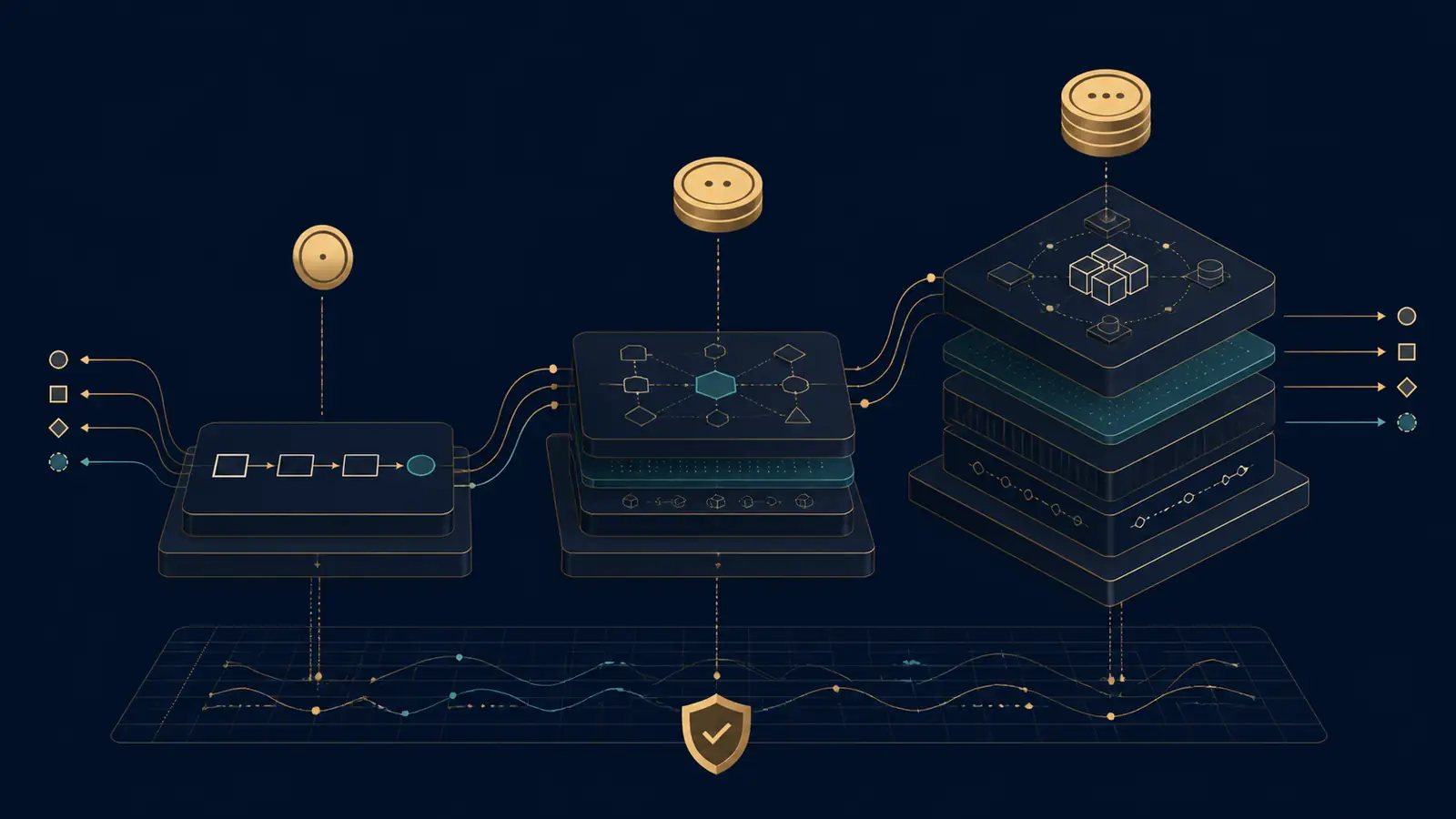
| Tool-using agent | A model can choose tools, iterate, and use environmental feedback | Tool contracts, permissions, approvals, retries, idempotency, and trace-based evaluation. The main variable is average model and tool steps per successful run. |
| Production-grade agent | A business-critical or multi-user system | Authentication, RBAC, isolation, sandboxing, audit logs, regression and red-team testing, rollout controls, backup and recovery, incident response, and model-change maintenance. |
These are design levels, not price bands. An illustrative example, such as preparing a customer-account research brief from approved sources for an account manager to review, can remain a simple workflow. It becomes a different project when it can select tools, write into several systems, or act under several user roles.
Separate paid scoping from one-time implementation
A paid scoping phase defines the target workflow, integrations, risks, acceptance tests, and operating assumptions. The scoping fee is credited only against implementation work accepted by JDTeachAI and the client.
The one-time implementation budget should separately identify:
- outcome and workflow definition, edge cases, and business ownership;
- data, system, API, credential, and permitted-document inventory;
- architecture, prompt and schema design, tools, connectors, and any interface;
- permissions, approvals, failure handling, retries, and idempotency;
- knowledge ingestion, evaluation dataset, acceptance tests, and human review;
- security and privacy work, deployment, migration, documentation, and training.
This keeps an initial discovery decision honest. It also lets a buyer decide whether the organization has the data owner, acceptance criteria, and operating model needed to accept implementation work. For an implementation brief, see custom AI projects.
Model monthly recurring costs with explicit inputs
Keep recurring operations visible even when a provider includes a free allowance or discounted rate. A practical monthly model is:
Monthly recurring cost =
  model usage
+ tool and search calls
+ retrieval, vector, and file storage
+ hosting, queues, and state
+ observability and evaluation
+ third-party subscriptions
+ maintenance, support, and incident response
For each model call, record uncached input, cache writes, cached input reads, and output:
Model cost per run =
  sum across all calls of
  uncached input × input rate
  + cache writes × write rate
  + cached input × read rate
  + output × output rate
  all divided by 1,000,000
Model expected, peak, and failure cases with run volume, average and high-percentile tokens, model and tool steps per run, search or retrieval frequency, retries, cache-hit rate, evaluation sampling, storage growth, and retention. A failure path matters because an autonomous agent can incur repeated calls and compound errors before the intended result is reached.
Representative public component prices, retrieved August 5, 2026
| Component | Public list example | What it makes visible |
|---|---|---|
| OpenAI GPT-5.4 mini, standard rate | US$0.75 per 1M input tokens and US$4.50 per 1M output tokens | Output volume, multi-step runs, and retries can matter more than a simple request count. OpenAI pricing |
| Gemini 3.1 Flash-Lite, standard rate | US$0.25 per 1M text, image, or video input tokens; US$0.50 per 1M audio input tokens; and US$1.50 per 1M output tokens, including thinking tokens | Model cost is only one input alongside storage, search, hosting, and operations. Gemini pricing |
| Cloudflare Workers Paid, Standard usage | US$5 monthly minimum, 10M requests included then US$0.30 per additional million, plus 30M CPU milliseconds included then US$0.02 per additional million | The base plan and CPU are separate from requests, queues, storage, and other infrastructure assumptions. Cloudflare Workers pricing |
These are public USD list examples retrieved on August 5, 2026, not market prices for professional services. Free allowances, batch or cache discounts, region, enterprise terms, taxes, and later pricing changes can alter them. They cannot be used to derive a development quote.
Fund evaluation, observability, and incident readiness
Evaluation is operational work, not decoration. OpenAI's agent evaluation guidance describes using traces, graders, datasets, and evaluation runs to inspect model calls, tool calls, guardrails, and handoffs. Read the OpenAI agent evaluations guide. Budget a representative test set, rejection criteria, human acceptance review, and regression checks when a model, prompt, tool, or integration changes.
Before launch, also name the owner for credentials, alerts, spend thresholds, logs, and incident response. Recurring work includes monitoring, support, fixes, regression testing, and model or prompt maintenance. For a related way to assess operating controls, see 12 AI automation examples and how to measure business ROI.
Questions to answer before requesting a quote
- What business result, trigger, source system, and system of record are in scope?
- Which actions are proposed, which are written, and which require approval?
- What data, documents, permissions, roles, and retention periods are permitted?
- Which normal volumes, peaks, failures, latency needs, and seasonal changes should be modeled?
- How will the buyer define an acceptable result, error, stop condition, and manual fallback?
- Who will own credentials, respond to alerts, and approve changes after delivery?
- What is included in scoping, implementation, acceptance testing, and ongoing support?
A useful quote makes those assumptions visible. It can then separate an initial scoping decision from implementation work that both JDTeachAI and the client accept, rather than disguising an unknown agent as a universal price.
FAQ about custom AI agent development cost
What is the average cost to build a custom AI agent?
There is no reliable average for a specific project. Cost changes with outcome ambiguity, integrations, permissions, knowledge, evaluation, security, and operations. Ask for a scenario with explicit assumptions instead of a number presented as a market norm.
Are API token prices enough to estimate the project?
No. They help model one recurring component through input, output, cache, tools, and retries. They do not price integrations, test design, security controls, acceptance work, or the operating responsibility after launch.
When is a simple workflow cheaper than an AI agent?
When a fixed path, explicit rules, and structured output satisfy the need. An agent can be appropriate when the number of steps cannot be predicted and the required controls remain practical. The added complexity should improve a measured outcome.
Is paid scoping credited toward the implementation?
At JDTeachAI, the scoping fee is credited only against implementation work accepted by JDTeachAI and the client. Scoping defines the workflow, risks, acceptance tests, and operating assumptions; it is not a market-rate reference.
What should be budgeted after launch?
Budget models, tools, retrieval and storage, infrastructure, observability, evaluation, subscriptions, support, incidents, and maintenance. Revisit those inputs when the volume, data, tools, or model changes.
If the need is clear but the delivery model is not, compare an AI automation consultant, agency, developer, and internal team.
For the next step, explore AI agents, start a custom AI project, or learn the method through AI coaching.