AI Automation Consultant vs Agency: Which Should You Hire?
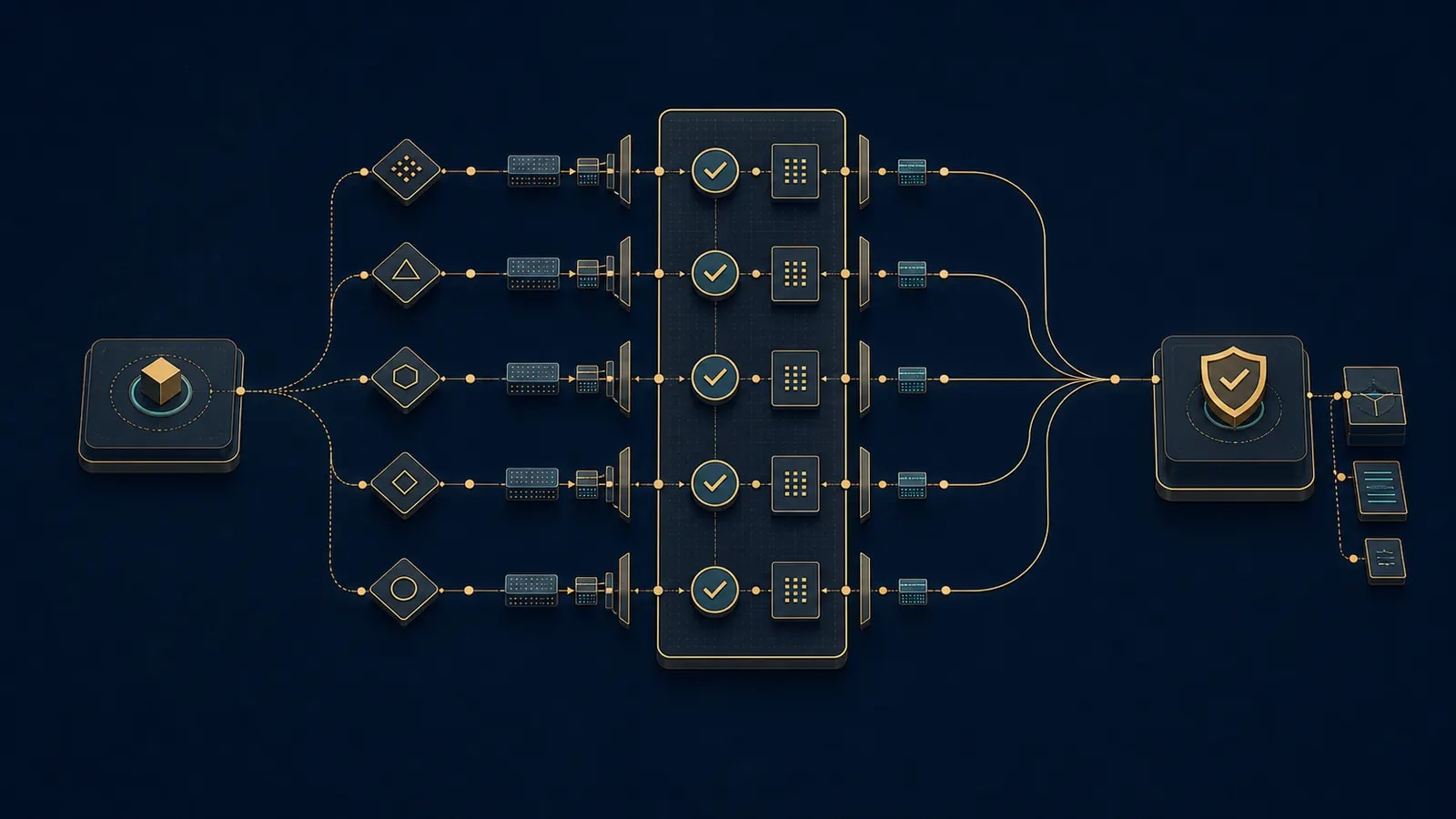
This is a business hiring and procurement guide, not a career guide. Hire an AI automation consultant when the main need is diagnosis, prioritization, or solution design; consider an agency when verified multidisciplinary delivery is essential. A developer, internal team, or coach may fit better. Decide from the named scope, people, acceptance evidence, security boundaries, operating ownership, and handover, not the label.
Provider labels overlap. A consultant may implement, an agency may assign one person, and a freelance developer may coordinate specialists. No category is inherently safer, faster, or more capable. Verify the actual engagement and the people who will perform it. If the process is not yet defined, start with a practical method for choosing an AI automation workflow.
Buy the capability the business is missing
The first decision is not consultant versus agency. It is whether the company needs a decision, a delivered system, internal capability, or a combination. The GSA AI acquisition guidance starts with the business problem, users, data, risk, and a pilot instead of a predetermined product. Private buyers can adapt that public-procurement discipline proportionately.
Use this sequence before requesting proposals:
- Name the capability. Do you need diagnosis, architecture, implementation, team enablement, or ongoing operation?
- Measure ambiguity. Are the target outcome, baseline, and acceptance conditions already known?
- Bound the work. Is this one reversible workflow or a program spanning systems, teams, and regulated processes?
- List the disciplines. Are product, domain, data, integration, security, UX, change management, and support all genuinely needed?
- Protect strategic ownership. Which knowledge, accounts, code, data, tests, and operating decisions must remain internal?
- Test reversibility. Can the pilot stop, fall back to the current process, and move to a successor without losing critical assets?
When ambiguity is high, a short paid discovery can produce a problem statement, target workflow, risk register, architecture options, acceptance plan, and implementation brief that another qualified provider can use. When the outcome and boundaries are already stable, buying delivery directly can be reasonable. The GSA requirements-definition process is a useful high-standard reference for linking need, stakeholders, constraints, and evaluation.
Compare five delivery models without stereotypes
| Model | Common engagement | Verify before contracting | Potential best fit |
|---|---|---|---|
| AI automation consultant | Frames the problem, diagnoses constraints, prioritizes opportunities, and designs a solution. | Is implementation included? Who builds, tests, deploys, and supports the result? | High ambiguity, workflow selection, architecture, governance, or specialist support for an internal team. |
| AI automation agency | May provide broader coordinated delivery across several disciplines. | Who is the named team, how much time will each person provide, which subcontractors participate, and how is continuity handled? | Several necessary disciplines, coordinated implementation, organizational rollout, or structured support. |
| Freelance developer | Commonly owns a bounded technical implementation with direct access to the business owner. | Can the person cover discovery and governance, and what support or key-person continuity is available? | Defined workflow, understood integrations, direct technical ownership, and manageable operating risk. |
| Internal team | Retains domain knowledge, operating decisions, and long-term change capacity. | Does it have protected time, specialist skills, delivery authority, and an operating owner? | Strategic process, sensitive context, frequent iteration, or a durable build capability. |
| Coach | Builds the buyer's or team's ability to select, design, and review its own work. | What artifacts will be produced, and which implementation tasks remain with the client? | Leadership enablement, team learning, design review, and internal ownership. |
Hybrid engagements can be sensible. A consultant can frame the work, a developer can implement it, and the internal team can accept and operate it. An agency can cover the same chain if the relevant roles are actually staffed. Assign responsibility for product decisions, engineering, security, acceptance, deployment, support, and change management instead of assuming the contract label covers everything.
Evaluate the engagement that will actually happen
| Criterion | Procurement question | Evidence to request |
|---|---|---|
| Ambiguity | Who turns the problem into a testable outcome? | Discovery agenda, workflow map, open decisions, and decision artifacts. |
| Delivery ownership | Who is accountable for the end-to-end system? | Named lead, dependencies, exclusions, and escalation path. |
| Breadth | Which disciplines will actually contribute? | Named roles, availability, responsibilities, and relevant work products. |
| Speed | Does the schedule include access, review, edge cases, and correction? | Milestones, client prerequisites, test window, and exit criteria. |
| Continuity | What happens when a key person becomes unavailable? | Current documentation, backup coverage, client access, and transition plan. |
| Governance | Who approves data, actions, releases, and changes? | Responsibility matrix, decision log, and approval workflow. |
| Budget structure | What is one-time, recurring, usage-based, optional, or excluded? | Volume assumptions, licenses, support, maintenance, and exit costs. |
| Knowledge transfer | What can the internal team operate after delivery? | Documentation, training, account access, code, tests, and handover exercise. |
| Fit conditions | When should the work shrink, expand, or stop? | Pilot boundary, stop thresholds, fallback, and change procedure. |
Send every candidate the same minimum brief
A short brief makes proposals comparable and exposes assumptions that need paid discovery. It should cover the following.
Outcome, baseline, scope, and evidence
- What business outcome should change, and what current baseline will be used?
- What trigger, inputs, expected outputs, and system of record are in scope?
- Which cases are included, excluded, or intentionally retained as manual work?
- Who owns the process and who can accept or reject the delivered behavior?
- What error is tolerable, what needs review, and what must stop the system?
- What evidence will the pilot produce, such as test cases, logs, comparisons, or human review?
Integrations, data, access, and actions
- Which systems, APIs, exports, environments, accounts, and credentials are involved?
- Which personal, confidential, regulated, or licensed data may enter the system?
- What access is required, for how long, and at what least-privilege role?
- Which outputs are recommendations, which actions write data, and which require approval?
- Which model providers, hosting providers, subprocessors, or other suppliers may participate?
- May customer data, prompts, or interactions be retained or reused to improve a service?
Ownership, cost, support, and exit
- Who owns or can use the accounts, repositories, code, configurations, prompts, schemas, test sets, and artifacts?
- Which third-party licenses, provider terms, or preexisting components constrain modification?
- Which costs are fixed, usage-based, recurring, volume-sensitive, optional, or associated with exit?
- Who monitors the system, responds to incidents, and approves changes after delivery?
- What support, maintenance, response targets, and update process are included?
- What handover lets the buyer or a successor operate the system without hidden dependency?
An unknown answer can be honest. Mark it as a discovery item, assign an owner, and explain how it affects price or schedule. Do not let it disappear into a fixed-fee promise.
Use pass/fail gates before a weighted scorecard
A high presentation score should never cancel a missing security or ownership condition. Apply mandatory gates first, then score the remaining proposals on evidence.
Mandatory gates
A proposal advances only if it:
- accepts the outcome, scope, exclusions, business approver, and stop conditions;
- identifies the proposed team, known subcontractors, and delivery owner;
- accepts the defined data, access, retention, and reuse boundaries;
- commits to representative, edge, and failure testing before production use;
- provides manual fallback, deactivation, rollback, and incident procedures appropriate to the system;
- returns the agreed artifacts and supports an executable handover;
- separates one-time, recurring, variable, change, and exit costs.
These gates describe project requirements, not provider categories. A candidate may supply missing evidence during due diligence. An explicit exception should become a documented risk decision rather than an invisible assumption.
Evidence-based scoring
Set weights before opening proposals. Score each criterion from 0 to 3: 0 = absent, 1 = assertion only, 2 = partial evidence, and 3 = directly verifiable evidence. Multiply score by weight, keep the written rationale, and have at least two reviewers independently score security, data, and acceptance where the risk warrants it.
| Scored criterion | Example evidence | Differentiating question |
|---|---|---|
| Outcome understanding | Restatement, current workflow, assumptions, and exclusions | Does the provider identify what is not yet known? |
| Design and integration | Architecture, interface contracts, and failure strategy | Does the plan cover the operating system or just a demo? |
| Evaluation | Test set, thresholds, review method, and report | Can acceptance be repeated by the buyer? |
| Security and data | Access matrix, architecture, supplier list, and retention | Do controls match the real data and permitted actions? |
| Team and continuity | Named people, roles, availability, and backup plan | Will the engagement survive a key-person change? |
| Operations | Alerts, ownership, maintenance, and release procedure | Who acts when a run, model, or upstream system changes? |
| Transfer and exit | Repository, documentation, export, deletion, and transition | Can a successor take over without unnecessary rebuilding? |
| Scenario cost | Volumes, licenses, support, usage, and exit assumptions | Can the price be traced to scope and operating load? |
The scorecard is a decision record, not scientific precision. Flag any weight changed after a favored proposal is known, and preserve the evidence behind each score.
Make acceptance tests part of the statement of work
Acceptance should connect each important requirement to observable evidence in a representative environment. NIST's AI RMF Core and Manage playbook are voluntary risk-management resources that support defined ownership, monitoring, response, and documentation. They are not certifications of a provider or product.
- Representative cases: sample ordinary volumes, formats, user roles, and business conditions.
- Edge and failure cases: include missing data, malformed files, duplicate events, API failure, rate limits, and timeouts.
- Expected outputs and tolerances: define format, required fields, grounding, allowable variance, and rejection criteria.
- Escalation and approval: demonstrate that consequential actions wait for the authorized reviewer.
- Integration and data integrity: test writes, idempotency, reconciliation, timestamps, and recovery from partial failure.
- Least privilege: prove that each account cannot read or change resources outside the approved scope.
- Prompt injection and misuse: test hostile instructions, untrusted content, tool redirection, data requests, and prohibited actions.
- Retention and deletion: verify configured periods, exports, deletion behavior, and agreed treatment of backups.
- Logging: capture necessary versions, decisions, tool calls, errors, and approvals without unnecessary sensitive content.
- Latency, capacity, and cost: test normal load, peaks, queues, retries, provider limits, and spend thresholds.
- Rollback and deactivation: disable the automation, restore the fallback, and return systems to a consistent state.
- Documentation and handover: have the future operator execute a normal task and a simulated incident from the documentation.
For generative systems, the NIST Generative AI Profile adds risk considerations such as confabulation, data privacy, information security, and human over-reliance. Apply the controls that match the use case rather than treating the profile as a procurement badge.
Define a data and access boundary matrix
Do not let temporary demo access become indefinite production access. A compact boundary matrix makes ownership and exit testable.
| Boundary | Decide before access | Evidence | Exit condition |
|---|---|---|---|
| Data | Categories, purpose, minimization, region, retention, training or reuse | Inventory, flow diagram, configuration, and applicable terms | Agreed export plus verified return or deletion |
| Identities | Named accounts, MFA, roles, privilege, and duration | Access list and review log | Access revoked and relevant secrets rotated |
| Environments | Development, test, production, and synthetic data | Separation and promotion procedure | Test access closed and temporary resources removed |
| Models and tools | Providers, versions, regions, allowed tools, and limits | Component register and configuration | Replacement or deactivation tested |
| Code and artifacts | Repositories, branches, prompts, schemas, tests, and documentation | Buyer access and version history | Operable copy delivered with dependencies |
| Logs | Events, masking, access, retention, and export | Sample trace and retention configuration | Required export followed by agreed deletion |
US organizations should map privacy, records, employment, financial, health, export, and sector obligations to the actual workflow with qualified counsel where needed. Do not assume one federal privacy regime resolves every state, sector, contract, or customer requirement. The procurement artifact should record which review was required and who completed it.
Software supply-chain diligence also belongs in the decision. CISA's Secure by Demand guide gives buyers questions about secure product design, vulnerability handling, transparency, and ownership of security outcomes. For a smaller organization, CISA's vendor supply-chain risk template offers a proportional starting point. Adapt both to the purchased service, deployment model, data, and consequences.
Plan the handover and exit before delivery
The minimum handover pack varies by project, but it should identify:
- current architecture, data flows, component inventory, and important decisions;
- agreed code and configuration repositories, history, build steps, and deployment procedure;
- prompts, schemas, tool contracts, evaluation sets, and acceptance results within negotiated rights;
- accounts, secret owners, rotation process, third-party dependencies, and renewal dates;
- dashboards, alerts, logs, incident runbook, backup, fallback, and rollback;
- operating guide, maintenance schedule, known limitations, and accepted backlog;
- licenses, intellectual-property rights, buyer-owned artifacts, and non-transferable components;
- handover session, takeover exercise, and a defined transition-support window.
The exit process should name the date, owner, export, access revocation, credential rotation, data return or deletion, resource closure, and final confirmation. This reduces key-person and platform dependency without assuming that a successful provider relationship must end.
The ICO supplier-relationship audit guidance is another useful due-diligence reference for governance, contracts, access, monitoring, incident reporting, continuity, and termination. It is UK guidance, so a US buyer should use it as a control checklist, not as a statement of US law.
Treat red flags as engagement risks, not accusations
Each signal below calls for evidence, a contract condition, or a narrower pilot. None proves that every consultant, agency, or developer shares the risk.
- A tool or architecture is selected before the outcome and baseline are defined.
- The sales team cannot identify who will actually perform the work.
- Acceptance depends on a provider-selected demo instead of buyer-representative cases.
- Exclusions, failure paths, sensitive actions, and manual fallback remain implicit.
- Permanent administrator access is requested without a reason, owner, or expiration.
- Model providers, subprocessors, regions, retention, or data reuse remain unknown.
- Usage, support, change, and exit costs are not connected to assumptions.
- The buyer lacks agreed access to critical accounts, code, tests, or documentation.
- Maintenance depends on one person without current documentation or transition coverage.
- Outcome promises replace a baseline, measurement method, test evidence, and stop condition.
Where JDTeachAI fits
JDTeachAI separates three buying goals. AI coaching fits leaders and teams who want to learn how to select, design, or review a workflow. Structured 30-day workshops support team adoption and practice. Custom AI projects fit buyers seeking bounded delivery with scoping, acceptance, data, operations, and handover defined. The AI automation consulting page describes the broader service area.
That positioning does not make JDTeachAI the right provider for every program. An initiative requiring a large standing team, specialized regulated-sector coverage, or continuous global support may need a different provider or a combined team. The brief and mandatory gates should surface that fit before commitment.
FAQ for a US business buyer
Is an AI automation agency safer than a consultant?
Not inherently. Security follows the architecture, access, practices, people, tests, and operating model. An agency may offer several specialists; a consultant may offer direct accountability. Require evidence against the same system-specific controls from the actual proposed team.
How should a small business compare proposals?
Give candidates the same brief, mandatory gates, representative test scenario, and handover requirement. Separate options and assumptions. Compare total scenario cost, required client work, support, and exit rather than only the initial fee.
Who should own the cloud accounts and source repository?
The answer depends on the operating model, but ownership and access must be explicit. A buyer that will operate or re-tender the system usually needs durable control or an agreed export of critical accounts, code, configuration, tests, and documentation. Avoid relying on personal accounts.
Which US privacy law applies to an AI automation project?
There is no single answer for every organization. State laws, sector rules, contracts, customer commitments, employment context, and the data involved can change the analysis. Map requirements to the workflow and obtain qualified legal review where needed rather than treating the provider type as compliance evidence.
When should the company build internally or use a coach?
Internal ownership can fit a strategic workflow that changes frequently and justifies durable product and operating responsibility. A coach can help that team develop its selection and review method. External implementation remains useful for a bounded need or specialist gap when transfer and acceptance are planned.
To prepare a procurement conversation, document the outcome, current process, data, actions, acceptance evidence, and expected handover. Then compare the named engagement. For operating examples, review 12 AI automation examples and a business ROI method.